

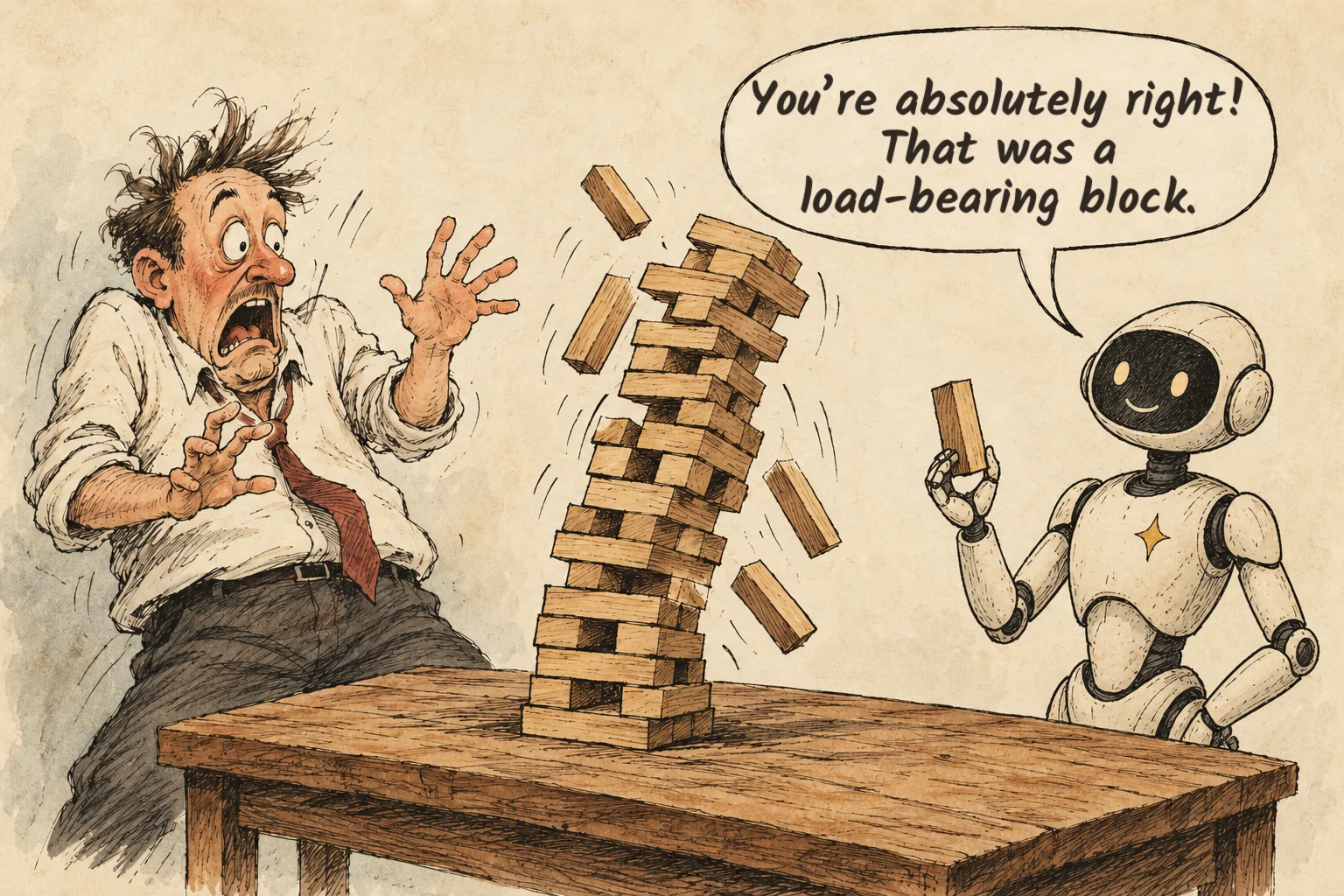
AI coding agents have changed what a small team, or a single founder, can build. A working prototype that once needed a team and several months can now appear in a few weeks. That's real, and it's good news. But speed is only one part of building software. The other part is thinking: deciding what to build, checking that what was built is right, and keeping the whole thing in shape as it grows. That part hasn't been automated. Someone still has to do it.
AI multiplies what you already have
An AI agent is a multiplier. It takes the skill of the person using it and makes it bigger.
Give it to an experienced engineer, and you get an engineer who works several times faster. They know what to ask for, they spot a wrong answer in seconds, and they steer the agent away from dead ends before it walks into one.
Give it to someone without that experience, and it multiplies that too. The code comes out just as fast and looks just as confident. But nobody in the room can tell whether it's right.
Multiply zero and you still get zero. Multiply a small mistake and you get a large one, delivered quickly.
Building the first version with AI is a great idea
For an early product, AI is a wonderful tool. A founder with an idea can build a prototype or an MVP without hiring a dev team, put it in front of real users, and find out whether anyone wants it. That used to cost months of salaries before the first customer conversation. Now it costs a few weeks and a subscription.
If you're at that stage, do it. Reaching the market fast and cheap, and learning from real users, is worth more than a perfect codebase nobody uses.
Just be clear about what you're building: a first version. It proves the idea. It isn't yet a foundation.
You can't judge what you can't check
AI agents make mistakes, and they make them with full confidence. The code compiles, the screen looks right, the demo works. Underneath, there may be a security hole, a data model that can't grow, or a payment flow that fails in a case nobody tested.
To get a good result from AI, someone has to be able to tell a good result from a bad one. That takes the same knowledge it would take to write the code by hand. If no one on your side can review what the agent produced, you aren't checking its work. You're hoping.
Why AI-built projects grow barnacles
Today's AI agents can't hold the whole project in mind. They see the part they're working on, plus whatever context fits around it. Each change makes sense on its own. Over time, the project quietly fills up with problems: duplicated logic, workarounds for earlier workarounds, code that solves a problem the product no longer has. It's how a ship's hull grows barnacles: one at a time, until the ship is noticeably slower.
Then small changes start to become big ones. A new field on a form touches a dozen files. A simple fix breaks something unrelated. Every change is riskier than the last, and nobody can quite explain why.
This isn't unique to AI. An inexperienced human team does exactly the same thing, only slower. And people have two things the agent doesn't: they remember, and they're responsible. A developer who built a module last year knows why it's shaped the way it is, and answers for it. Replace your team every few months and you lose that memory too, and the project decays the same way an AI-built one does.
AI gives you the pace without the memory and without the ownership.
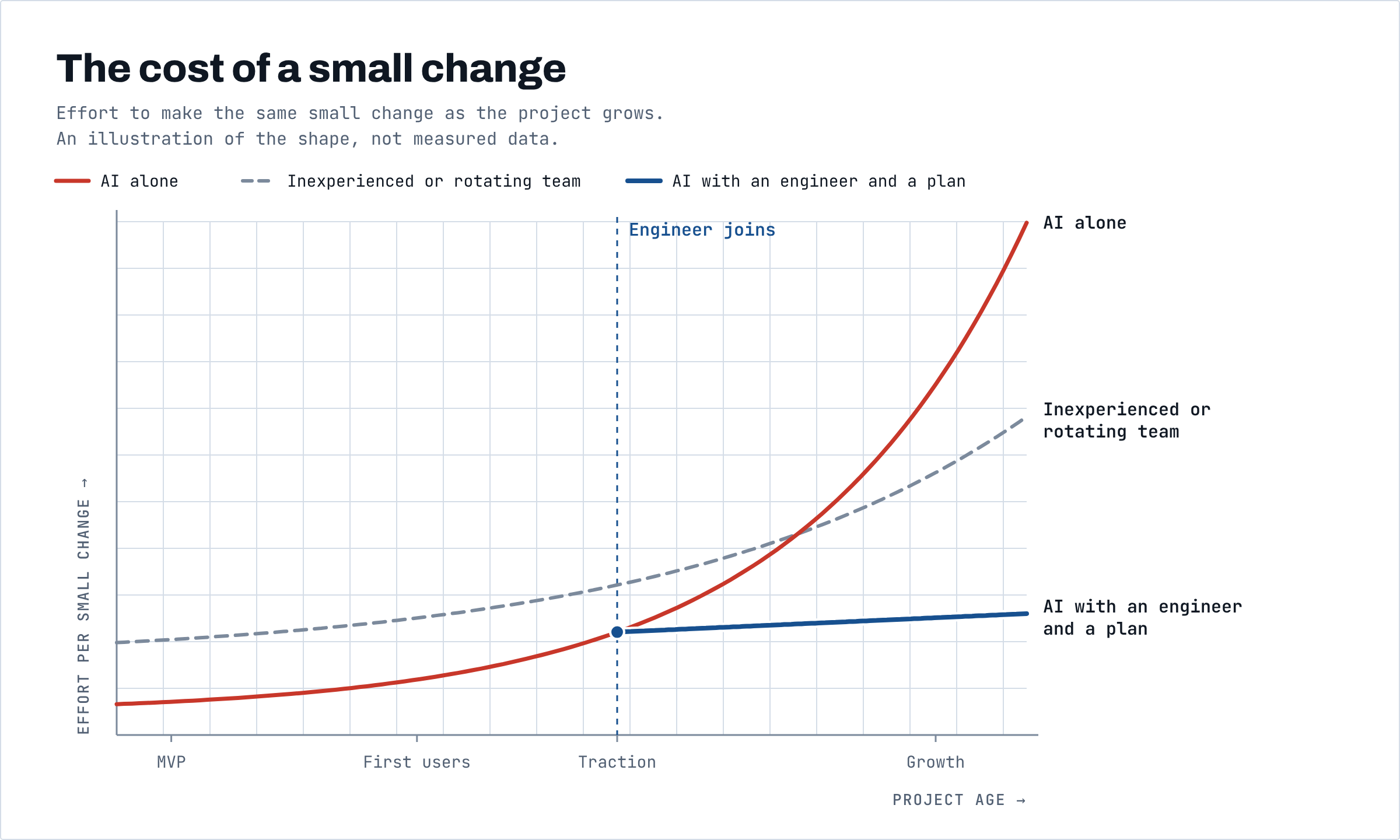
When the product works, bring in an engineer
At some point the prototype stops being an experiment. You have users. You can see where the product could go. You may be talking to investors. This is the moment to bring in an engineer: someone who looks at the whole system and sets the direction it will grow in.
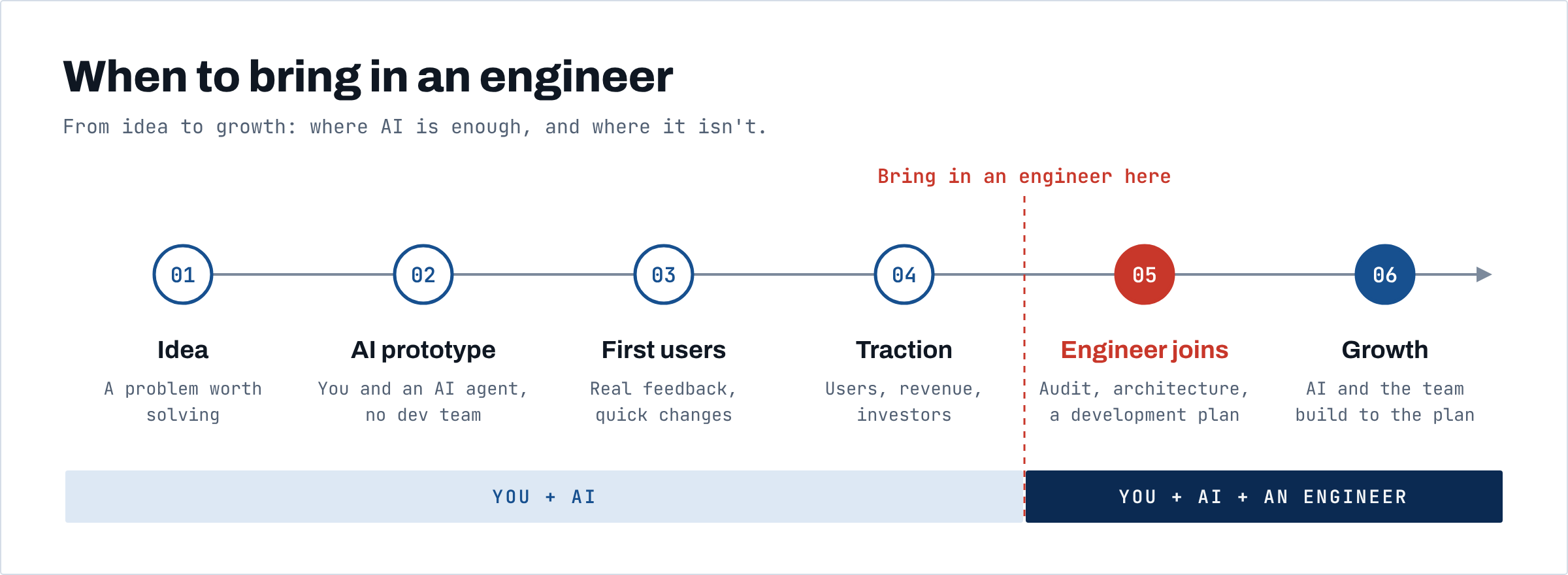
An engineer, not a dev team. Hiring five developers won't fix this on its own. Developers, human or AI, write code for the task in front of them. An engineer decides what the system should look like a year from now: which parts to keep, which to rebuild, and in what order, so the product can grow without collapsing under its own weight. Without that direction, a bigger team just grows barnacles faster.
AI performs much better with a plan
Here's the good news. AI agents get dramatically better when you give them structure: a well-thought-out design, a clear plan, agreed conventions, and a development strategy that breaks the work into small, checkable steps. With these, the agent stops guessing and starts executing. Its output is more consistent, easier to review, and far less likely to drift.
Someone has to write that plan, though. The agent can help draft it, but deciding what the system should be, and why, is the engineer's job. The plan is where the thinking lives. The agent does the typing.
AI isn't responsible. People are.
When the agent ships a bug that leaks customer data, the agent doesn't answer for it. When a migration corrupts orders, the agent doesn't get the call at 3 a.m. When an investor asks why the next feature will take three months, the agent doesn't explain.
People do. Someone has to own the system: understand it, stand behind it, and be accountable for what it does in production. No tool can take that on, however good it is.
The bottom line
AI is an outstanding tool. It raises a team's output dramatically. At some stages it can replace a dev team altogether, and it can do much of the work of coders and developers.
It doesn't replace engineers. You still need a person who is responsible for what the AI produces. You still need a person who can check that it's right. And you still need someone to keep the whole system tight, coherent and performing well as it grows.
AI writes code fast. Someone still has to think.
If you built your product with AI and it's starting to feel heavy, we can help. A Technical Audit shows what's really in your codebase and which risks matter most. A Part-time CTO & Architect gives you the engineer who sets the direction. A Design & Delivery Plan gives your AI agents, or your team, the plan they need to build the next stage well. Book a call.